
Data and measures
The School Survey on Crime and Safety is run by the National Center for Education Statistics. It goes to the principal of a nationally representative sample of US public schools. Six of its rounds carry the eight community-involvement questions this study draws on: 2005-06, 2007-08, 2015-16, 2017-18, 2019-20 and 2021-22.
Each round asks the principal whether the school works with each of eight kinds of outside organization: parents' groups, civic groups, local businesses, churches, social services, mental-health providers, juvenile justice agencies and the police. This study counts seven of them. Parents' groups are asked about and not counted, because a parents' group is part of the school itself.
15,195 principals answered all eight questions. Of those, 2,504 said they work with all seven counted organizations or with none, and they are set aside, leaving 12,691 school responses. Putting them back raises the main estimate from +0.104 to +0.129.
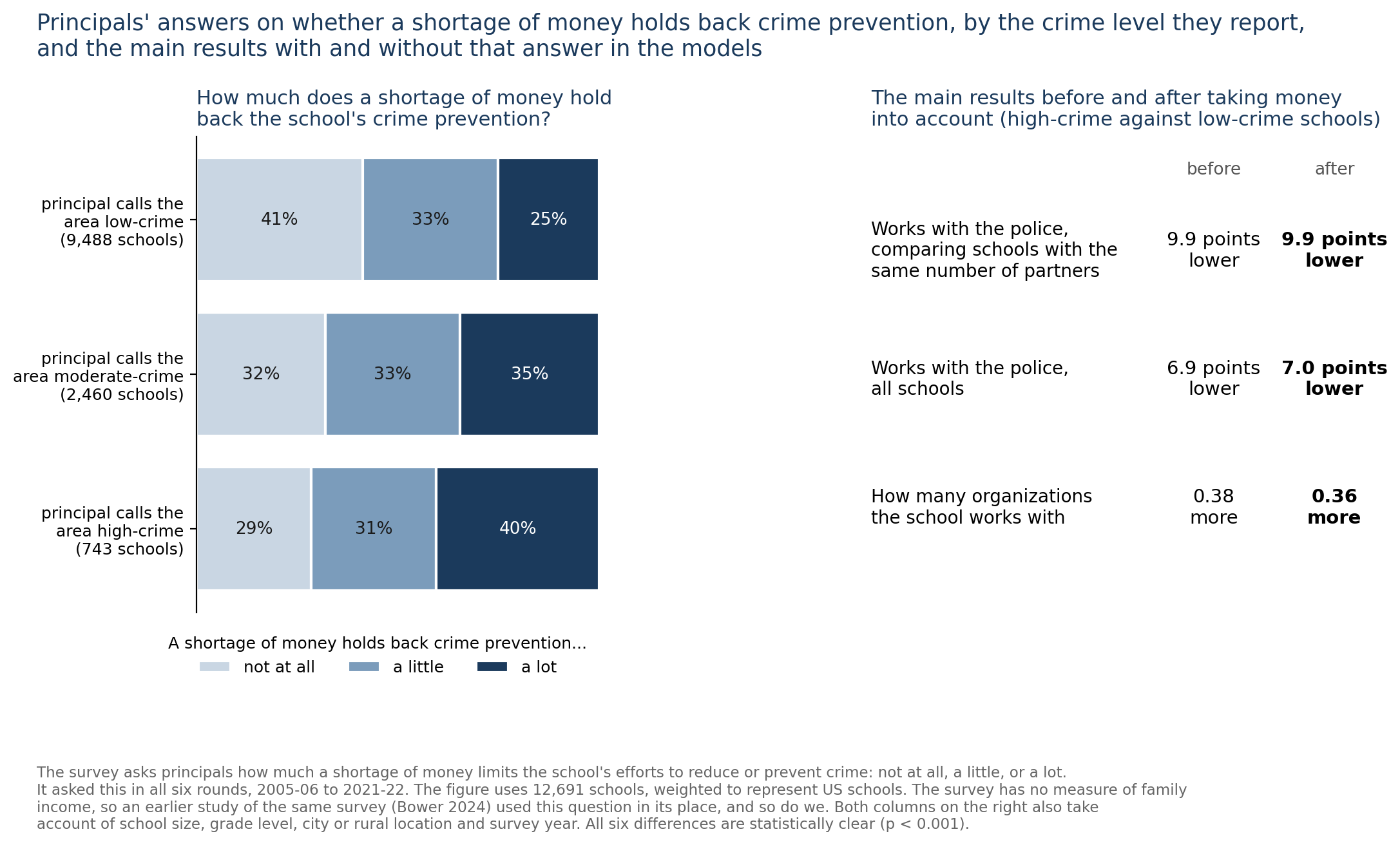
Every adjusted estimate compares schools of the same size, grade level, city or rural location and survey year, where a lack of funds limits the school's crime prevention to the same degree. The survey has no measure of a school's resources, such as family income. So, like Erica Bower (2024), we use the principal's answer on whether inadequate funds limit the school's efforts to reduce or prevent crime, which is no limit, a minor limit or a major limit. That answer rises with the crime reading: a major limit is reported by 25% of schools in areas called low-crime and by 40% in areas called high-crime. Adding it to the models leaves the police result unchanged.
The table gives, for each answer, how many schools gave it, how many outside organizations those schools work with on average, and how many of them work with the police, work with mental-health providers and have their own security staff. Schools that say a shortage of money holds back their crime prevention a little or a lot work with more organizations on average than schools that say it does not. Every figure is weighted to represent US schools.
| A shortage of money holds back crime prevention | Schools | Organizations, on average | Work with the police | Work with mental-health providers | Have their own security staff |
|---|---|---|---|---|---|
| not at all | 4,847 | 3.26 | 83% | 63% | 54% |
| a little | 4,329 | 3.53 | 86% | 68% | 57% |
| a lot | 3,515 | 3.45 | 83% | 68% | 57% |
Resource dependence, one of the two theories this study tests, expects this. It says an organization short of what it needs turns to other organizations, and it counts as resources more than money: services, staff time, expertise, information and standing. Each of the seven organizations supplies some of these. So a school that says it is short of money and works with more partners fits the theory, whichever partners it adds. The difference holds with the crime reading and the school's own staff and equipment taken into account, at +0.210 of an organization for "a little" and +0.132 for "a lot", and among schools whose principals call the area low-crime. The question asks about money for crime prevention, so a principal may answer "a lot" because the school is trying to do a lot as well as because it has little. The survey cannot separate the two.
Every figure on this site is weighted using the survey's own weights, so that it describes US schools rather than the sample. Unweighted percentages of this survey are simply wrong. Standard errors are clustered on the sampling stratum crossed with the survey round, which gives 365 clusters. Clustering on the stratum alone would give 64, which is wrong, because the stratum codes are reused from one round to the next.
What these numbers cannot show
Every number here is an association, and three limits follow from that. None of them is small.
Each survey measures everything at one moment, and no school is followed over time. A fresh sample of schools is drawn each round. So we can say that schools in areas their principals call high-crime work with more organizations. We cannot say the area caused it, and we cannot rule out that the connections came first.
The crime measure is the principal's description of the area, not a recorded crime statistic. That is deliberate, because what an organization does about its surroundings depends on how it reads them. But it means the measure carries whatever a principal's judgement carries.
Everything is self-reported by one person per school. Nobody checked the answers against the organizations named.
Reproducing the numbers
Every estimate reported here is rebuilt by two implementations that share no code and agree on
all 76 checked numbers, standard errors included. reproduce.R is native R with one
dependency, and prints each estimate next to the number the paper reports with a MATCH or DIFFERS
flag. A Python pipeline produces the same tables independently. The six SSOCS public-use files are
free from NCES.
The code archive is minted when the paper is submitted, and this page will link to it then. Until then, write to ron.levi@utoronto.ca for the scripts.
Supplementary material
The manuscript keeps five tables in its body and files the other fourteen as supplementary. This site draws no such line: all nineteen tables and all five figures are on the Tables & figures page, in the order the argument uses them, and every caption also gives the number the analysis pipeline assigned it.
The supplementary methods, which are not reproduced here, describe the exponential random graph model's terms, the curveball randomization test, the multilevel and pairwise checks, and the screening of all 87 survey items.
References
Adler, P. S. and Kwon, S.-W. (2002). Social capital: prospects for a new concept. Academy of Management Review 27(1): 17–40.
Ahuja, G. (2000). The duality of collaboration: inducements and opportunities in the formation of interfirm linkages. Strategic Management Journal 21(3): 317–343.
Aiken, M. and Hage, J. (1968). Organizational interdependence and intra-organizational structure. American Sociological Review 33(6): 912–930.
Armstrong, T. A., Armstrong, G. S. and Katz, C. M. (2015). Testing the influence of community characteristics on school misconduct. Justice Quarterly 32(5): 792–817.
Baum, J. A. C. and Oliver, C. (1991). Institutional linkages and organizational mortality. Administrative Science Quarterly 36(2): 187–218.
Baum, J. A. C., Calabrese, T. and Silverman, B. S. (2000). Don't go it alone: alliance network composition and startups' performance in Canadian biotechnology. Strategic Management Journal 21(3): 267–294.
Beckman, C. M., Haunschild, P. R. and Phillips, D. J. (2004). Friends or strangers? Firm-specific uncertainty, market uncertainty, and network partner selection. Organization Science 15(3): 259–275.
Bower, E. (2024). It takes a village: examining social capital effects of parental and community agency involvement on school delinquency. The Social Science Journal 61(3): 625–638. https://doi.org/10.1080/03623319.2020.1848292
Breiger, R. L. (1974). The duality of persons and groups. Social Forces 53(2): 181–190.
Bressers, H. and O'Toole, L. J. (1998). The selection of policy instruments: a network-based perspective. Journal of Public Policy 18(3): 213–239.
Burt, R. S. (1992). Structural Holes: The Social Structure of Competition. Cambridge, MA: Harvard University Press.
Coleman, J. S. (1988). Social capital in the creation of human capital. American Journal of Sociology 94(Supplement): S95–S120.
Cook, K. S. (1977). Exchange and power in networks of interorganizational relations. The Sociological Quarterly 18(1): 62–82.
Emerson, R. M. (1962). Power-dependence relations. American Sociological Review 27(1): 31–41.
Epstein, J. L. and Sheldon, S. B. (2002). Present and accounted for: improving student attendance through family and community involvement. Journal of Educational Research 95(5): 308–318.
Gottfredson, G. D., Gottfredson, D. C., Payne, A. A. and Gottfredson, N. C. (2005). School climate predictors of school disorder: results from a national study of delinquency prevention in schools. Journal of Research in Crime and Delinquency 42(4): 412–444.
Gulati, R. (1999). Network location and learning: the influence of network resources and firm capabilities on alliance formation. Strategic Management Journal 20(5): 397–420.
Gulati, R. and Gargiulo, M. (1999). Where do interorganizational networks come from? American Journal of Sociology 104(5): 1439–1493.
Hunter, D. R., Handcock, M. S., Butts, C. T., Goodreau, S. M. and Morris, M. (2008). ergm: a package to fit, simulate and diagnose exponential-family models for networks. Journal of Statistical Software 24(3).
Kirk, D. S. (2009). Unraveling the contextual effects on student suspension and juvenile arrest: the independent and interdependent influences of school, neighborhood, and family social controls. Criminology 47(2): 479–520.
Krackhardt, D. (1988). Predicting with networks: nonparametric multiple regression analysis of dyadic data. Social Networks 10(4): 359–381.
Levine, S. and White, P. E. (1961). Exchange as a conceptual framework for the study of interorganizational relationships. Administrative Science Quarterly 5(4): 583–601.
Lin, N. (2001). Social Capital: A Theory of Social Structure and Action. Cambridge: Cambridge University Press.
Lin, N. and Dumin, M. (1986). Access to occupations through social ties. Social Networks 8(4): 365–385.
Metz, F., Leifeld, P. and Ingold, K. (2019). Interdependent policy instrument preferences: a two-mode network approach. Journal of Public Policy 39(4): 609–636.
National Center for Education Statistics (2022). Crime, Violence, Discipline, and Safety in U.S. Public Schools in 2019-20: Findings From the School Survey on Crime and Safety (NCES 2022-029). Washington, DC: U.S. Department of Education.
National Center for Education Statistics (n.d.). School Survey on Crime and Safety (SSOCS). nces.ed.gov/programs/crime/ssocs, accessed July 2026.
Oliver, C. (1991). Strategic responses to institutional processes. Academy of Management Review 16(1): 145–179.
Pfeffer, J. and Salancik, G. R. (1978). The External Control of Organizations: A Resource Dependence Perspective. New York: Harper & Row.
Podolny, J. M. (2001). Networks as the pipes and prisms of the market. American Journal of Sociology 107(1): 33–60.
Powell, W. W., Koput, K. W. and Smith-Doerr, L. (1996). Interorganizational collaboration and the locus of innovation: networks of learning in biotechnology. Administrative Science Quarterly 41(1): 116–145.
Sanders, M. G. (2001). The role of "community" in comprehensive school, family, and community partnership programs. Elementary School Journal 102(1): 19–34.
Selznick, P. (1949). TVA and the Grass Roots: A Study in the Sociology of Formal Organization. Berkeley: University of California Press.
Sendroiu, I. and Levi, R. (2023). World society corridors: partnership patterns in the spread of human rights. Social Forces 102(1): 377–401.
Sharkey, P. (2018). Uneasy Peace: The Great Crime Decline, the Renewal of City Life, and the Next War on Violence. New York: W. W. Norton.
Sharkey, P., Torrats-Espinosa, G. and Takyar, D. (2017). Community and the crime decline: the causal effect of local nonprofits on violent crime. American Sociological Review 82(6): 1214–1240.
Sheldon, S. B. and Epstein, J. L. (2002). Improving student behavior and school discipline with family and community involvement. Education and Urban Society 35(1): 4–26.
Singh, J. V., House, R. J. and Tucker, D. J. (1986). Organizational legitimacy and the liability of newness. Administrative Science Quarterly 31(2): 171–193.
Small, M. L. (2009). Unanticipated Gains: Origins of Network Inequality in Everyday Life. New York: Oxford University Press.
Stuart, T. E., Hoang, H. and Hybels, R. C. (1999). Interorganizational endorsements and the performance of entrepreneurial ventures. Administrative Science Quarterly 44(2): 315–349.
Wilson, W. J. (1987). The Truly Disadvantaged: The Inner City, the Underclass, and Public Policy. Chicago: University of Chicago Press.